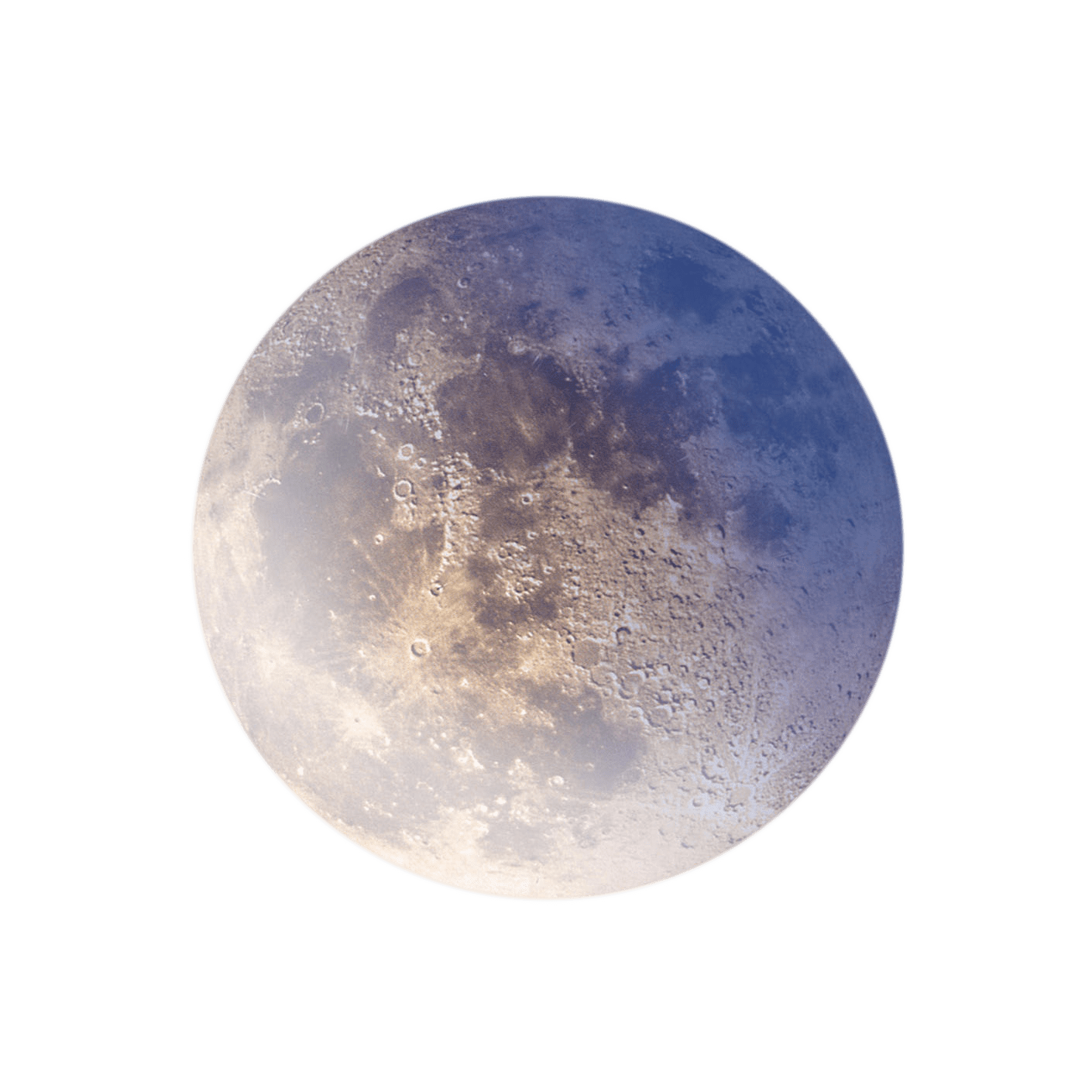
Earth's Moon
The fifth largest moon in the solar system, Earth's moon is the only place beyond Earth where humans have set foot.
10 Need-to-Know Things About the Moon
-
SMALL COMPANION
If you set a single green pea next to a U.S. nickel, you'd have a pretty good idea of the size of the Moon compared to Earth.
-
CONSTANT COMPANION
The Moon is Earth's only natural satellite. It goes around the Earth at a distance of about 239,000 miles (385,000 kilometers).
-
LOCKED UP
The Earth and Moon are tidally locked. Their rotations are so in sync we only see one side of the Moon. Humans didn't see the lunar far side until a Soviet spacecraft flew past in 1959.
-
CAN STAND ON IT
The Moon has a solid, rocky surface cratered and pitted from impacts by asteroids, meteorites, and comets.
-
BRING A SPACESUIT
The Moon has a very thin and tenuous atmosphere called an exosphere. It is not breathable.
-
MOONLESS
The Moon has no moons.
-
RINGLESS
The Moon has no rings.
-
MANY VISITORS
More than 105 robotic spacecraft have been launched to explore the Moon. It is the only celestial body beyond Earth – so far – visited by human beings.
-
POTENTIAL FOR LIFE?
The Moon's weak atmosphere and its lack of liquid water cannot support life as we know it.
-
MOONWALKERS
Apollo astronauts brought back a total of 842 pounds (382 kilograms) of lunar rocks and soil to Earth. We are still studying them.
Exploration

With Earth Blue, Rocket Red and Lunar Silver for colors, every part of the identity has meaning. Credit: NASA
The former Soviet Union logged the first successes with its Luna program, starting with Luna 1 in 1959. NASA followed with a series of robotic Ranger and Surveyor spacecraft that performed increasingly complex tasks that made it possible for the first human beings to walk on the Moon in 1969.
Twenty-four humans have traveled from the Earth to the Moon. Twelve walked on its surface. The last human visited the lunar surface in 1972.