Jupiter
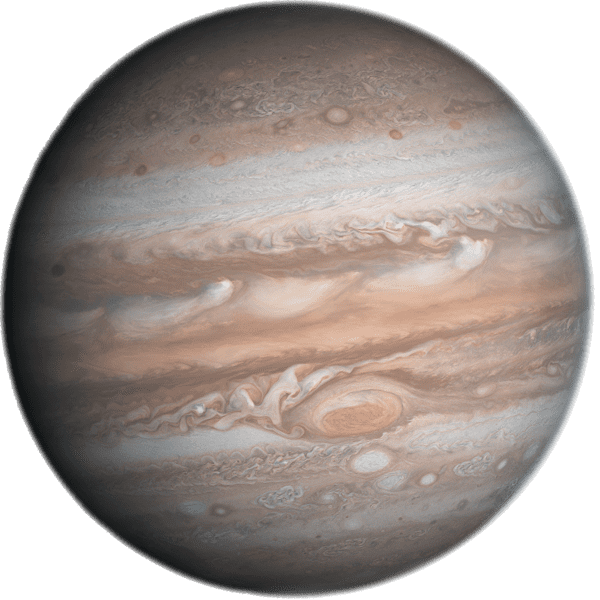
Jupiter is more than twice as massive than the other planets of our solar system combined. The giant planet's Great Red Spot is a centuries-old storm bigger than Earth.
10 Need-to-Know Things About Jupiter
-
THE GRANDEST PLANET
Eleven Earths could fit across Jupiter’s equator. If Earth were the size of a grape, Jupiter would be the size of a basketball.
-
FIFTH PLANET FROM OUR STAR
Jupiter orbits about 484 million miles (778 million kilometers) or 5.2 Astronomical Units (AU) from our Sun (Earth is one AU from the Sun).
-
SHORT DAY/LONG YEAR
Jupiter rotates once about every 10 hours (a Jovian day), but takes about 12 Earth years to complete one orbit of the Sun (a Jovian year).
-
WHAT'S INSIDE
Jupiter is a gas giant and so lacks an Earth-like surface. If it has a solid inner core at all, it’s likely only about the size of Earth.
-
MASSIVE WORLD, LIGHT ELEMENTS
Jupiter's atmosphere is made up mostly of hydrogen (H2) and helium (He).
-
WORLDS GALORE
Jupiter has more than 75 moons.
-
RINGED WORLD
In 1979 the Voyager mission discovered Jupiter’s faint ring system. All four giant planets in our solar system have ring systems.
-
EXPLORING JUPITER
Nine spacecraft have visited Jupiter. Seven flew by and two have orbited the gas giant. Juno, the most recent, arrived at Jupiter in 2016.
-
INGREDIENTS FOR LIFE?
Jupiter cannot support life as we know it. But some of Jupiter's moons have oceans beneath their crusts that might support life.
-
SUPER STORM
Jupiter's Great Red Spot is a gigantic storm that’s about twice the size of Earth and has raged for over a century.
Exploration
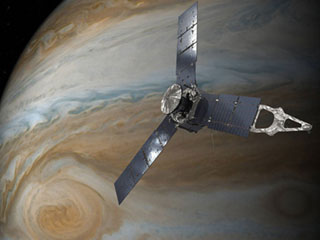
Pioneer 10 and 11 and Voyager 1 and 2 were the first to fly by Jupiter in the 1970s, and since then we’ve sent Galileo to orbit the gas giant and drop a probe into its atmosphere. Cassini took detailed photos of Jupiter on its way to neighboring Saturn, as did New Horizons on its quest for Pluto and the Kuiper Belt. NASA’s Juno spacecraft, which arrived in the Jovian system in July 2016, is currently studying the giant planet from orbit.