Saturn
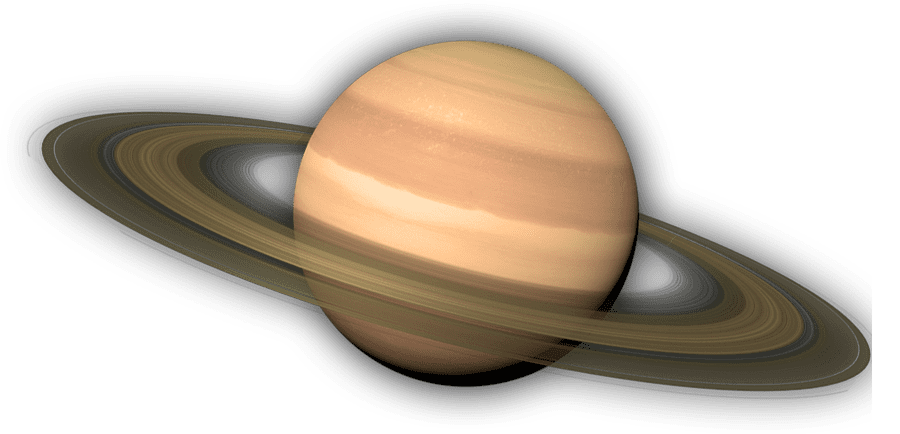
Adorned with a dazzling, complex system of icy rings, Saturn is unique in our solar system. The other giant planets have rings, but none are as spectacular as Saturn's.
10 Need-to-Know Things About Saturn
-
A COLOSSAL PLANET
Nine Earths side by side would almost span Saturn’s diameter. That doesn’t include Saturn’s rings.
-
IN DIM LIGHT
Saturn is the sixth planet from our Sun (a star) and orbits at a distance of about 886 million miles (1.4 billion kilometers) from the Sun.
-
SHORT DAY, LONG YEAR
Saturn takes about 10.7 hours (no one knows precisely) to rotate on its axis once—a Saturn “day”—and 29 Earth years to orbit the sun.
-
GAS GIANT
Saturn is a gas-giant planet and therefore does not have a solid surface like Earth’s. But it might have a solid core somewhere in there.
-
HOT AIR
Saturn's atmosphere is made up mostly of hydrogen (H2) and helium (He).
-
MINI SOLAR SYSTEM
Saturn has 53 known moons with an additional 29 moons awaiting confirmation of their discovery—that is a total of 82 moons.
-
GLORIOUS RINGS
Saturn has the most spectacular ring system, with seven rings and several gaps and divisions between them.
-
RARE DESTINATION
Few missions have visited Saturn: Pioneer 11 and Voyagers 1 and 2 flew by; But Cassini orbited Saturn 294 times from 2004 to 2017.
-
LIFELESS BEHEMOTH
Saturn cannot support life as we know it, but some of Saturn's moons have conditions that might support life.
-
ADD A DASH OF EARTH
About two tons of Saturn’s mass came from Earth—the Cassini spacecraft was intentionally vaporized in Saturn’s atmosphere in 2017.
Exploration
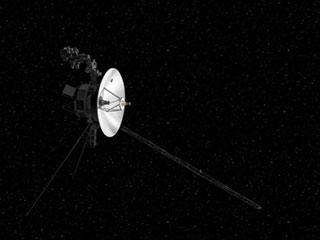
Each flyby revealed intriguing details about the ringed giant world, but it wasn't until the international Cassini mission arrived in orbit in 2004 that our understanding of Saturn really started to take shape. Cassini studied Saturn from orbit for 13 years before its human engineers on Earth transformed it into an atmospheric probe for its spectacular final plunge into the planet in September 2017. Cassini also carried ESA's Huygens Probe, which landed on Saturn's moon Titan in 2005.
From Earth, astronomers have studied Saturn with telescopes for centuries. And the Hubble Space Telescope continues to uncover new details from its perch in Earth orbit.